At the heart of AI transformation lies the Model Context Protocol (MCP), a framework enabling AI agents to communicate with tools, databases, and services. This article addresses a sobering reality: these systems inherit all the security challenges of traditional automation while introducing entirely new attack surfaces.
The rise of AI agents has ushered in a new era of automation: One where large language models orchestrate complex workflows, make decisions, and interact with systems on our behalf. At the heart of this transformation lies the Model Context Protocol (MCP), a framework enabling AI agents to communicate with tools, databases, and services. Yet beneath the excitement of agentic AI lies a sobering reality: these systems inherit all the security challenges of traditional automation while introducing entirely new attack surfaces.
At CoGuard, we've spent years securing infrastructure and automation pipelines. As we watched MCP and similar protocols emerge, we recognized familiar patterns and early stage gaps which closed over the course of time with maturity. The promise of AI agents calling functions, accessing data, and executing commands is remarkable. But who verifies those calls? How do we ensure the back-end systems they interact with are hardened against malicious or malformed requests? What happens when an agent, however well-intentioned, is manipulated through prompt injection or context poisoning?
The answer isn't simply better prompts or smarter models. It's defense in depth: securing every layer from the agent's decision, making process to the APIs it calls, the servers that respond, and the infrastructure that provisions them. This is the story of how CoGuard is addressing the security challenges of tomorrow's agentic infrastructure—today.
The Familiar Foundation: What MCP Inherits from Decades of Automation
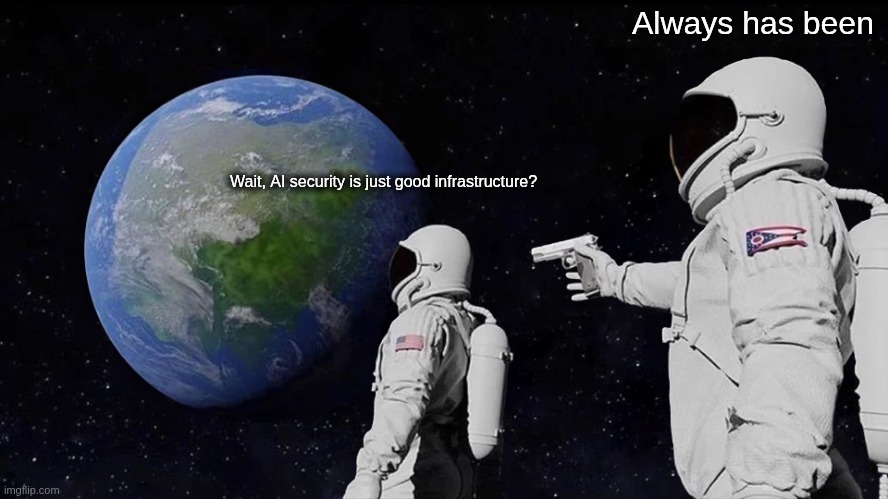
If the challenges of securing AI agents feel strangely familiar, there's a good reason: we've been here before.
The organizations that thrived during the API economy weren't necessarily those with the biggest budgets, they were the ones with mature engineering practices and robust access control frameworks. Companies that understood how to create scalable, well-governed interfaces between systems found themselves able to rapidly integrate third-party services, automate workflows, and unlock new business models. Those that treated APIs as an afterthought faced breaches, service disruptions, and integration nightmares.
The same pattern emerged during cloud migrations. Organizations that simply lifted their on-premises architecture into AWS or Azure saw minimal returns and often increased complexity. Those that truly succeeded reimagined their systems around cloud-native principles: ephemeral infrastructure, identity-based security, and automation at every layer.
MCP servers and agentic workflows follow this same trajectory. The fundamental challenge hasn't changed: how do you grant external entities,whether APIs, cloud services, or now AI agents, enough power to be useful while maintaining the controls necessary to stay secure?
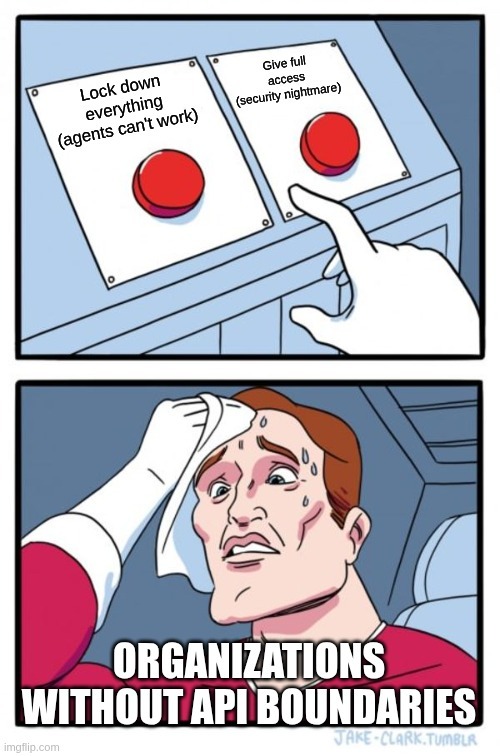
Consider the parallel to managing outsourced human contractors. You don't give them unrestricted root access to production systems, but you also can't lock them into environments so restrictive they can't perform the job they were hired to do (or need to wait for certain resources at every step they take). Effective organizations create controlled environments with appropriate guardrails: scoped permissions, audit trails, isolated workspaces, and clear boundaries. The goal is empowerment within constraints.
AI agents demand the same approach, perhaps even more urgently. They need controlled yet scalable access to tools, data, and infrastructure. This means:
Well-defined APIs with strict input validation and rate limiting
Rigorous testing regimes that catch edge cases before agents encounter them in production
Automated enforcement of security policies, not manual reviews after incidents
Operational observability to detect when agents behave unexpectedly
Organizations with high adaptability, those willing to rethink their architecture rather than bolt MCP onto legacy systems, will see the greatest returns. The infrastructure principles remain constant. Only the actors have changed.
There is an old saying that applies here: there is no AI without IA (information architecture).
The New Frontier: Where MCP Diverges from Traditional Automation
For all their similarities to past paradigms, AI agents introduce a fundamental shift that changes everything: the loss of determinism.
Traditional automation pipelines are predictable. Given the same input, a script or API call produces the same output every time. You can unit test them, integrate them, and deploy with confidence. Even early machine learning systems, while probabilistic, operated within bounded domains with clear evaluation metrics.
AI agents, powered by large language models, shatter this predictability. The same prompt can yield different responses. Agents can misinterpret instructions, hallucinate data, or take unexpected paths to achieve goals. We're back to a challenge we haven't faced at this scale since the early days of ML, but now it's pervasive across every workflow, not isolated to prediction models.
This means you can't just test the system once and trust it forever. Like managing human employees, you must monitor both inputs and outputs continuously.
Resource Constraints and Economic Realities
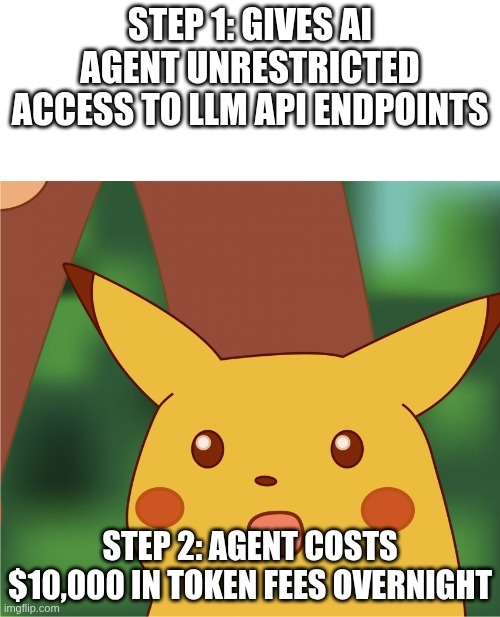
Unlike traditional automation, every agent action has a direct cost: token consumption. LLM API calls aren't just about rate limiting anymore; they require quota management. An agent stuck in a reasoning loop or making redundant calls can burn through budgets as fast as it can generate responses.
Organizations need:
Token budgets per agent, per workflow, per time window
Call pattern analysis to detect inefficient agent behavior
Automated circuit breakers when costs spike unexpectedly
Bounded Interactions: The API Layer is Your Moat
Here's where architectural discipline separates the secure from the compromised: agents should never have direct, low-level system access.
Letting an agent write and execute raw SQL queries? That's not agentic innovation, it's an injection attack waiting to happen. The organizations that will succeed are those that already have well-architected systems with:
API-first design where all data access flows through controlled interfaces
RBAC or attribute-based access control enforced at the API layer, as well as the database layer.
Input validation and output sanitization as first-class concerns
If your infrastructure lacks mature API boundaries, MCP adoption will expose every shortcut and architectural debt you've accumulated. Conversely, if you've already invested in secure, well-documented APIs with proper access controls, enabling AI agents becomes a matter of mapping permissions and workflows, not rebuilding your entire stack.
Injection Attacks: An Old Threat, Amplified
SQL injection. Command injection. Cross-site scripting. We've fought these battles for decades. Now add prompt injection and context poisoning to the mix.
An AI agent doesn't just execute what you tell it: it interprets, reasons, and synthesizes from multiple sources. Malicious data in a document, a compromised API response, or even a cleverly crafted user input can hijack the agent's decision-making process. Unlike traditional injection attacks that target specific parsing vulnerabilities, prompt injection exploits the agent's core function: understanding and acting on natural language with the ability to execute embedded functions.
The solution isn't better prompts. It's architectural containment.
Input and output must be controlled at every stage:
Schema validation before data enters the agent's context
Output sanitization before results are committed or presented
Workflow state machines that enforce valid transitions, not open-ended "figure it out" instructions.
Engineering for Bounded Autonomy
The best parallel here is the evolution of parallel programming. Early adopters tried to throw threads at problems and hope for speedups. Experienced engineers learned to identify clear, decomposable tasks with well-defined interfaces and synchronization points.
AI agents demand the same discipline. Your job isn't to tell an agent "handle customer support somehow with these 50 tools." It is to:
Identify the business process with clear stages and decision points
Design deterministic checkpoints where inputs and outputs are validated
Create bounded workflows where each step has defined success criteria
Implement circuit breakers that halt execution when validation fails
Security through prompts is security theater. Real security comes from architecture: least-privilege access, defense in depth, and continuous verification.
Trust, but verify, at every layer, at every step, automatically.
The organizations that will excel with MCP aren't those hoping their agents will "just work." They're the ones building testable, observable, and controllable workflows where human engineers define the guardrails and agents operate within them. Where determinism can't be guaranteed through code alone, it must be enforced through architecture: validation gates, approval checkpoints, and automated monitoring that flags anomalous behavior before it propagates.
This is the core principle: AI agents should be treated as untrusted actors with supervised capabilities, not autonomous systems with blanket permissions. Every function they call, every API they access, every piece of data they touch must flow through layers of verification. The flexibility of natural language reasoning is their strength, and their risk. Your architecture must account for both.
How CoGuard Prepares You for the Agentic Future
The path to secure AI agents doesn't start with choosing the right LLM or writing the perfect prompt. It starts with establishing scalable architectural guardrails long before your first agent makes its first API call.
Defense in depth isn't a nice-to-have—it's the foundation. And defense in depth means configuration security at every layer: your cloud infrastructure, your container orchestration, your databases, your APIs, your secrets management, your network policies. If any of these layers is misconfigured, your AI agents will inherit and potentially exploit those weaknesses at machine speed.
This is where CoGuard enters the picture.
Building the Foundation: Configuration as Security Policy
CoGuard's mission has always been to make infrastructure security scalable through automation. We analyze configurations across your entire stack: Kubernetes, Docker, Terraform, database configs, web servers, CI/CD pipelines—and identify misconfigurations before they become vulnerabilities.
When you're preparing for MCP and agentic workflows, this becomes critical:
Are your API endpoints properly authenticated and rate-limited?
Do your databases enforce least-privilege access?
Are your secrets rotated and never hardcoded?
Is your network segmentation actually enforced, or just documented?
CoGuard guides you through this journey. By following our recommendations, you're not just fixing individual issues, you're building the automation and architectural discipline necessary to move fast with confidence. You're creating an environment where:
Changes are tested before deployment
Security policies are enforced programmatically
Drift is detected and remediated automatically
Teams can innovate without constantly second-guessing their security posture
With this foundation in place, defining, controlling, and deploying AI agent workflows becomes possible, not as a security gamble, but as a natural extension of your already-hardened infrastructure.
The Future: Infrastructure as Code for AI Agents
We're still early in the MCP ecosystem, but patterns are emerging. Just as Terraform brought declarative infrastructure provisioning and Ansible brought configuration management, we expect a DSL (domain-specific language) to emerge for MCP servers and their connectors.
Today, setting up an MCP server means writing code: scripts, API handlers, authentication logic, error handling, rate limiting, etc.. All implemented from scratch or pieced together from libraries. This works for early adopters and experimenters, but it doesn't scale. As use cases mature and best practices crystallize, the community will demand a better way.
Imagine a future where you define an MCP server like this:
<pre><code class="language-yaml">
mcp_server:
name: customer-data-api
auth:
type: oauth2
client_id: your_id
rate_limit: 100/minute
quota:
input_tokens_per_agent_per_day: 100000
output_tokens_per_agent_per_day: 100000
tools:
- name: get_customer
endpoint: /api/v1/customers/{id}
permissions: [read:customers]
input_schema: customer_id.json
output_validation: customer_response.json
</code></pre>
Where security controls, authentication methods, rate limiting, input validation, RBAC, are configuration options, not implementation details. Where best practices are enabled with a setting, not hundreds of lines of boilerplate code.
This DSL will come. As organizations deploy MCP at scale, the patterns will emerge, tools will consolidate, and the community will converge on standards. The timeline is unclear, months, a year, perhaps longer, but the direction is inevitable.
And when that DSL arrives, CoGuard will be ready to check it.
Just as we analyze Terraform for cloud misconfigurations and Kubernetes manifests for security gaps, we'll integrate with the MCP provisioning ecosystem to ensure:
Authentication is properly configured
Rate limits and quotas are set appropriately
Input validation schemas are comprehensive
Access controls follow least-privilege principles
Logging and monitoring are enabled
Secrets are managed securely, not hardcoded
Be Ready Before the Standard Exists
You don't need to wait for the DSL to start preparing. By hardening your infrastructure today with CoGuard, you're building the muscle memory and automation practices that will make adopting MCP, and whatever comes after, seamless.
Organizations that wait will find themselves scrambling to retrofit security after deployment. Those that establish configuration hygiene, automated testing, and defense-in-depth architecture now will have the foundation to move quickly and confidently.
CoGuard doesn't just check your configurations, it trains your team to think architecturally about security. Every recommendation we surface is an opportunity to ask: "Why was this configured this way? What's the secure alternative? How do we prevent this class of issue systematically?"
By the time MCP provisioning DSLs become the norm, you won't be learning security practices while trying to deploy agents. You'll be applying patterns you've already mastered, in a new domain, with tooling that makes enforcement even easier.
The future of AI agents is being built today, on the infrastructure you're configuring right now. CoGuard ensures that foundation is solid, so when your agents start making decisions, accessing data, and orchestrating workflows, they're operating in an environment designed from the ground up to contain, monitor, and control them.
The controls you need tomorrow start with the configurations you verify today.
Conclusion
The rise of AI agents and the Model Context Protocol represents a genuine inflection point in how we build and operate systems. The potential is immense: workflows that adapt, scale, and solve problems with unprecedented flexibility. But that same flexibility, without proper constraints, becomes a liability.
History has taught us this lesson repeatedly. Organizations that bolted APIs onto insecure backends suffered breaches. Those that migrated to the cloud without rethinking architecture saw costs spiral and vulnerabilities multiply. Every technological leap rewards those who build on solid foundations and punishes those who move fast without moving carefully.
MCP and agentic workflows are no different.
The winners won't be those with the most sophisticated prompts or the largest context windows. They'll be the organizations that understood a simple truth: AI agents are only as secure as the infrastructure they operate within.
This means:
Hardened configurations at every layer
Well-defined APIs with robust access controls
Automated testing and continuous verification
Architectural discipline that treats agents as untrusted actors with supervised capabilities
CoGuard exists to make this vision achievable, not as a distant aspiration, but as an operational reality you can implement today. By securing your configurations now, you're not just preventing breaches. You're building the foundation for tomorrow's agentic systems.
The future of AI infrastructure is being written in the configuration files, API designs, and security policies you create today. Make sure they're worth building on.
Start securing your infrastructure now. Be ready for the agentic future.
Oops! Something went wrong while submitting the form.
Check out and explore a test environment to run infra audits on sample repositories of web applications and view select reports on CoGuard's interative dashboard today.